

Distributed Cognitive Escalation: How Digital Systems Turn Belief Into Identity

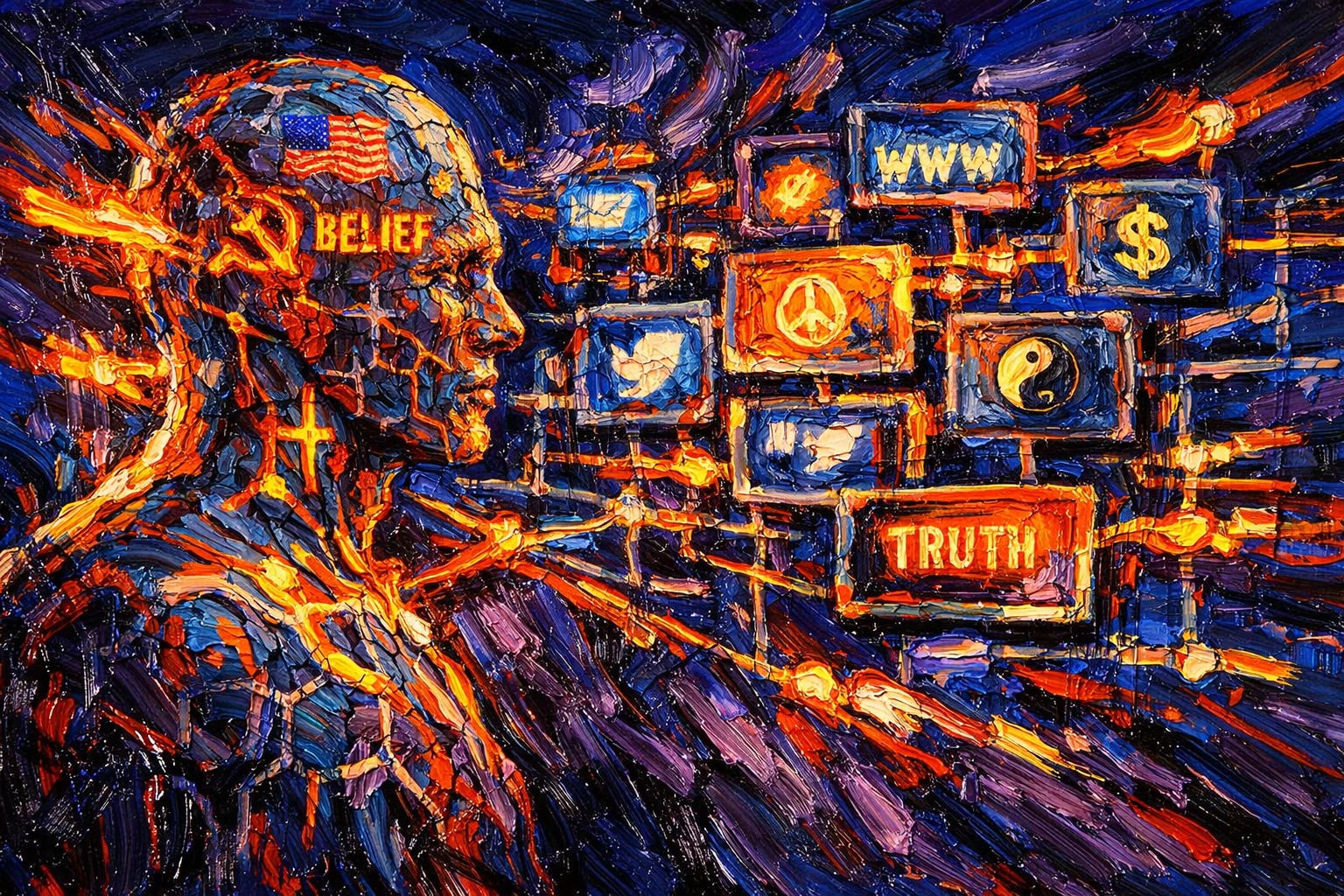
Most conversations about radicalization focus on ideology. People argue about politics, extremism, culture, or geopolitics. But that often misses the deeper shift that has taken place.
The real change is not just what people believe. It is how those beliefs become part of who they are.
Digital platforms do not simply spread information. They shape the conditions under which identity forms.
That distinction matters.
When Belief Becomes Identity
There is a meaningful difference between holding a belief and being defined by one.
At first, a belief feels optional. It is something you agree with. You can discuss it. You can adjust it. You might even change your mind.
But when a belief fuses with identity, something shifts. Disagreement feels personal. Counterarguments feel threatening. Compromise feels like betrayal.
Social identity research has long shown that people derive part of their sense of self from group membership. When an idea becomes linked to belonging, it stops functioning as a claim to evaluate. It becomes something to defend.
Digital systems accelerate that shift.
Repetition Makes the Unfamiliar Feel Normal
Psychologists have known for decades that repeated exposure increases perceived truthfulness. Even weak claims begin to feel credible when encountered again and again.
Online environments amplify this effect. Algorithms reward engagement. Engagement tends to cluster around emotionally charged material. As a result, users often encounter the same narratives repeatedly, especially if they react to them.
Over time, something subtle happens.
An idea that once seemed extreme begins to feel familiar. Familiarity reduces resistance. What once felt outrageous begins to feel normal.
That is often the first step in identity hardening.
Social Reinforcement Changes the Stakes
Beliefs do not exist in isolation. They live in communities.
On digital platforms, approval is visible. Likes, reposts, comments, and shares signal agreement. Public affirmation reinforces commitment. Silence or criticism can trigger defensiveness.
Once someone expresses a belief publicly, it becomes reputational. Walking it back carries social cost.
Social identity theory explains why this matters. People want coherence between their beliefs and their group membership. If the group stabilizes around certain narratives, individuals align themselves accordingly.
What begins as social alignment gradually becomes internal conviction.
Drawing Lines: Us and Them
Group identity strengthens when boundaries sharpen.
Research in intergroup psychology consistently shows that perceived threat from an outgroup increases cohesion within the ingroup. The clearer the boundary, the stronger the identity.
Digital networks cluster people with similar views. Shared grievances intensify inside these clusters. Language shifts. The conversation becomes less about policy and more about loyalty.
Once identity is anchored in opposition, compromise becomes psychologically expensive.
The debate is no longer about what is true. It becomes about who is loyal.
When Beliefs Become Moralized
Some beliefs are preferences. Others become moral commitments.
When an idea is framed as righteous or sacred, it resists cost-benefit reasoning. Sacred values research demonstrates that once a belief is moralized, pragmatic trade-offs feel unacceptable.
Online narratives frequently escalate into moral language. Political disagreements become existential struggles. Opponents are not mistaken. They are corrupt or dangerous.
When morality fuses with identity, flexibility declines sharply.
Escalation Through Social Competition
Public commitment increases investment. This is well established in research on commitment and consistency.
In tightly bonded online communities, social status can become tied to intensity. Members may signal stronger conviction to gain recognition. Positions harden not because someone ordered them to, but because extremity earns attention.
Radicalization in such cases can emerge through competition rather than coordination.
Belonging becomes linked to escalation.
Organic Drift and Intentional Activation
It is important to distinguish two possibilities.
Identity hardening can emerge organically from network dynamics. Selective exposure, repetition, reinforcement, and group boundaries are sufficient to generate polarization without central direction.
At the same time, those same psychological levers can be deliberately activated. Increasing repetition. Amplifying reinforcement. Intensifying outgroup framing. Moralizing grievances.
The structural process looks similar either way. The difference lies in intent and coordination.
That distinction is critical.
AI Changes the Scale
Artificial intelligence does not invent these mechanisms. It accelerates them.
Sentiment analysis can detect grievance signals. Automated accounts can simulate reinforcement. Messaging can adapt to emotional tone in real time.
What once required an active community can now be replicated more efficiently.
The cost of influence drops. The speed increases.
Identity and Behavioral Rigidity
When beliefs fuse with identity, behavior becomes more predictable.
Flexibility declines. Deviating from the group carries reputational risk. Counterarguments are filtered through identity defense.
This does not automatically produce violence. It does produce rigidity.
Rigidity narrows interpretive space. Ambiguous events are interpreted through hardened frames. Escalation thresholds can lower when identity feels under threat.
The system becomes less adaptable.
The Cognitive Environment
Digital platforms are not neutral conduits. They shape exposure patterns, reinforce certain behaviors, and cluster identities into dense networks.
Belief formation in this environment is not random. It follows structural pressures.
Understanding how identities harden is not about labeling disagreement as extremism. It is about recognizing the mechanisms that convert ideas into identity commitments.
The more identity fuses with belief, the harder it becomes to reintroduce flexibility.
And in an era where influence can be amplified at scale, that rigidity has consequences.